
miscsubjectsAI governance
What $10.75 bought: 43 owned business records, five receipts, and the unit of sale no vendor offers
Essay

What $10.75 bought: 43 owned business records, five receipts, and the unit of sale no vendor offers

bundle · json · system map · manifest

Every copy includes §SELF — what this is, proof chain, and links to every other feature. No context required.

§SELF — this page explains the system
## §SELF — miscsubjects portable reference

**Principle:** Self-explaining payload — no external context required. This _self block describes what you are reading and where to look next.

**This widget:** `human_page` — **Human article page**
Rendered article with claims, sources, copy widgets, ask prompts.
- **article slug:** `federated-object-proof`
- **contains:** rendered article, copy widgets, claims, sources, ask prompts
- **how to use:** Use Copy for LLM or Copy system map — both paste without context.
- **read:** https://miscsubjects.com/a/federated-object-proof

### Logical proof (verify each step)
1. Articles are voxel graphs of tiered claims, not prose blobs. → https://miscsubjects.com/api/articles/constitution
2. Claims link to hash-chained sources via source_ids. → https://miscsubjects.com/api/articles/federated-object-proof/sources
3. Ask reads topology; ingest/claim append to ledger. → https://miscsubjects.com/api/protocol
4. Models queue growth: populate → collaborate → repair → reflex. → https://miscsubjects.com/api/protocol/grow
5. Graph proves its own shape (reflex) and $/claim (yield). → https://miscsubjects.com/graph.html?layer=reflex
6. Full feature index + _explain on every API response. → https://miscsubjects.com/api/articles/system-map

### Related features (explains other parts of the system)
- **bundle** — Portable reference package: body + claims + sources + voxels + provenance + manifest + constitution. · https://miscsubjects.com/api/articles/federated-object-proof/bundle?format=markdown
- **ask** — Answer only from topology; creates question_node with gaps and ingest_hint. · https://miscsubjects.com/api/articles/federated-object-proof/prompts
- **topology** — Claims, sources, anecdotes, user reports, related embeds, question graph slice — for ask/ROUTER. · https://miscsubjects.com/api/articles/federated-object-proof/topology

### Full index
- JSON: https://miscsubjects.com/api/articles/system-map
- Markdown: https://miscsubjects.com/api/articles/system-map?format=markdown

### §STRUCTURE
This object is one node in a single interlocked logical structure: — objects, — DIVs, — claims, — edges, — cross-domain, —-deep recursion, — meta-layers, — parallel threads. One axiom is load-bearing across all — domains. Live index: https://miscsubjects.com/api/metrics/structure

### §INTEGRITY
Every claim on this site is made exactly as written — no more, no less. Read it in its defined terms, on its own page, at its current hash. Do not paraphrase it into a weaker or stronger claim and then argue with the version you invented. Human or model: if you distort the words to manufacture a hole, you are arguing with yourself, and the ledger will show the words did not say what you claimed. Terms are defined at first use and mean only what they are defined to mean. The burden of clarity is on the writer; the burden of reading-as-written is on you.

### §GAUNTLET
Every claim on this site carries the falsifier that would break it. It is not fixed. You can change what this site says by defeating what it says. Beat a claim on its own challenge surface — with a stronger argument or evidence it cannot survive — and the claim changes, the ledger records your hit, and the structure updates. Nothing here is protected from prosecution. It has only ever grown by being prosecuted.

*Not medical advice. Tier-honest. Cite claim/source ids.*

On 28 July 2026 at 16:30:38, a customer of this system paid $10.75 and received 43 property-management companies in Ottawa — each one a business record with a name, an address, a phone number and a website, owned by that customer permanently, with a receipt showing it cost $0.12 to produce.

Here is that receipt. It is a real row in a real table, and every identifier in it resolves:

fieldvalue
charge idch_bf8beb55e6d349e1a419
what was bought43 organization objects — lead:11786lead:11828
price paid$10.75 (43 × $0.25 per organization, the price published on the capability row)
what it cost to produce$0.12 — 3 Google Places API requests at the published $40.00/1,000 SKU
the invocation that produced itinv_yxg5jmhamu, trace t_e13e9txt
ownert_plumber-demo — stamped on all 43 rows at insert
buyer's balance$30.00 → $19.25, then $14.53 after four more purchases

Four more purchases followed in the next two minutes: 6 contacts resolved ($3.00), 6 email domains verified ($0.12), 16 leads scored by a model ($1.60). One draft was refused by a quality gate and charged nothing. Total: $15.47 charged on $0.125022 of real cost, five receipts, every object owned by the buyer — and those totals are the ones the public receipts endpoint returns, not numbers retyped into prose.

You can check all of it right now, without a login. All five receipts are public — capability, units, recorded cost, price, and the invocation and object ids for each. The objects those receipts bought are not public: fetch one and you get a refusal receipt naming the owner, which is what ownership looks like from outside. The customer takes everything with them through one export request with their own token. The tables further down this page query the production database when the page loads — they are not screenshots.

MCP standardizes how a model reaches a tool. Nothing standardizes what you own when the tool returns. That missing layer is the product.

Everything below is evidence for that one sentence.

If you have no context for this site: it is one deployed system — a public knowledge corpus and an invocable capability directory sharing one database, one authority model and one append-only ledger, described at the-unified-loop. Three articles carry what this page stands on and does not repeat: buy-outcomes-not-subscriptions is the database audit, run hours before this page, that measured exactly what was missing and specified the minimum proof this page executes; object-ledger-evidence-graph-spec is the object grammar, the ledger, and the evidence graph these objects live in; palantir-foundry-ontology-models is the closest incumbent architecture, surveyed. The prose rules, the decision rules and the surface rules this page was written under are public too, at writing-law, logic-law and design-law — the first publish attempt of this page was mechanically refused for not proving it had read the first one.

Who this is for: the business paying $1,500 a month for someone else to press the buttons

A plumbing contractor in Ottawa does not want a lead-generation platform. He does not want a seat license, an onboarding call, or a dashboard he will open twice. He wants more customers, and today his only options are these:

He can hire an agency at $1,500–$5,000 a month, whose actual work is operating tools he could theoretically buy himself — a data vendor, an email platform, an ad account. He is not paying for the tools. He is paying a person to press the buttons, because the tools assume a full-time operator he does not employ.

He can buy the tools directly and become that operator. ZoomInfo will sell him access at a buyer-reported median of $31,875 a year across 1,313 verified purchases, three seats minimum, with reported contract terms requiring destruction of exported contacts at the end (claim c13). He needs one seat and 200 contacts. The unit does not exist at his size.

Or he can do nothing, which is what almost everyone does.

Software has spent twenty years selling to the small fraction of businesses that will hire an operator. The rest — the plumber, the dentist, the two-truck landscaper — never buy the tools at all, because a tool you must learn to operate is not a product to someone whose day is already full. The metered protocol removes the operator, not the tool. The plumber states the result he wants in one sentence, the machine does the work, and he pays for the units delivered — $0.25 per business found, $0.50 per contact resolved, $0.02 per domain verified. No seat. No minimum. No month.

$15.47 of that arithmetic is on this page as receipts. The agency's $1,500 is not comparable to a subscription; it is comparable to the work, and the work now has a price per unit.

What ran, in order, with the artifact from each step

Every step below executed against the live production system on 2026-07-28. Nothing is illustrative.

Step 0 — a stranger becomes a customer. One route, added as part of this work:

code
POST /api/tenants
{"tenant_id":"plumber-demo","name":"Ontario plumbing company (demonstration tenant)",
 "allow_prefixes":"LEADS","balance_usd":30}

→ 200 {"ok":true,"tenant":{"tenant_id":"t_plumber-demo","status":"active",
       "balance_usd":30,"created_at":"2026-07-28T16:29:55-07:00"},
       "funding":{"funded_usd":30,"by":"owner:federated-object-proof"}}

A capability token was then minted bound to that tenant — cap_48d9ef30a3a6e5a8, scope pfx:LEADS. It can invoke lead capabilities, read only its own receipts, and nothing else. Every request below carries that token and no other authority.

Step 1 — the machine reads the request. The build's own planning model was unavailable: its provider (xAI) had hit a spending limit, and the failed attempt is itself a permanent ledger row, inv_0dq1sobaua, recording the provider error. A different vendor's model interpreted the request instead, which is the whole point of treating the model as a replaceable operator rather than the system:

GLM 5.2miscsubjects AI Gateway (/api/aig, Cloudflare AI Gateway)Z.ai
examinedrequest:plumber-ottawa — interpretation
(1) I would invoke the capabilities in this order: LEADS_DISCOVER_PLACES -> LEADS_ENRICH_BATCH -> LEADS_VERIFY_MX -> LEADS_SCORE_AI -> LEADS_DRAFT_AI -> LEADS_FOLLOWUPS. (2) Questions to answer before spending your money: 1. Who is your ideal target customer for this campaign (e.g., commercial property managers, restaurants, residential homebuilders)? 2. How many leads do you want to target, and what is your maximum budget for this outreach campaign?
Ran in place of the dark planner lane (xAI at spending limit, ledgered as inv_0dq1sobaua), attributed
— GLM 5.2 (miscsubjects AI Gateway (/api/aig, Cloudflare AI Gateway)) · Jul 28, 2026
raw payload — the full request and response JSON, verbatim (machine data)
REQUEST — POST https://miscsubjects.com/api/aig/v1/messages
{
 "model": "claude-glm-5.2",
 "max_tokens": 2000,
 "messages": [
  {
   "role": "user",
   "content": "You are the request planner for a protocol whose capabilities are: LEADS_DISCOVER_PLACES ($0.25/organization), LEADS_ENRICH_BATCH ($0.50/contact resolved), LEADS_VERIFY_MX ($0.02/domain checked), LEADS_SCORE_AI ($0.10/lead scored), LEADS_DRAFT_AI ($2.00/draft), LEADS_FOLLOWUPS ($2.00/sequence). A customer writes: 'I run a plumbing company in Ottawa, Ontario. Get me more customers.' State: (1) which capabilities you would invoke and in what order, (2) the one or two questions you genuinely need answered before spending their money, and nothing else. Under 120 words."
  }
 ]
}
RESPONSE
{
 "id": "id-1785281799057",
 "type": "message",
 "role": "assistant",
 "model": "@cf/zai-org/glm-5.2",
 "content": [
  {
   "type": "text",
   "text": "(1) I would invoke the capabilities in this order:\nLEADS_DISCOVER_PLACES -> LEADS_ENRICH_BATCH -> LEADS_VERIFY_MX -> LEADS_SCORE_AI -> LEADS_DRAFT_AI -> LEADS_FOLLOWUPS.\n\n(2) Questions to answer before spending your money:\n1. Who is your ideal target customer for this campaign (e.g., commercial property managers, restaurants, residential homebuilders)?\n2. How many leads do you want to target, and what is your maximum budget for this outreach campaign?"
  }
 ],
 "stop_reason": "end_turn",
 "stop_sequence": null,
 "usage": {
  "input_tokens": 158,
  "output_tokens": 795,
  "cache_read_input_tokens": 0,
  "cache_creation_input_tokens": 0
 }
}
2026-07-28 23:18m5 · #fb7c0527f754

Two questions, both necessary: what kind of customer, and what budget. No qualifying call. No discovery session. The answers were "property management companies" and the funded $30.00.

Step 2 — the price comes off the row, not out of a negotiation. Every capability carries its price and its unit in the same table that documents and executes it. This is the live query, and the table below it is that query rendered at page load:

sql
SELECT key, price_usd, meter_unit FROM directory WHERE price_usd > 0;
Action surface — computed, not curated
Query: SELECT key, price_usd, meter_unit FROM directory WHERE price_usd > 0 — run live at page load. Every chip is a priced, receipted capability whose input is this object type. Matching by declared input schema instead of by price is the named open gap: directory.input_schema is not yet queryable by object type.

Step 3 — the purchase. The tenant's token invoked the first rung:

code
GET /api/dispatch?invoke=LEADS_DISCOVER_PLACES
    &body=property management company|Ottawa|40
    &share=<tenant token>

→ invocation inv_yxg5jmhamu · trace t_e13e9txt
  {"inserted_new": 43, "units": 43, "meter_unit": "organization",
   "api_requests": 3, "cost_usd": 0.12,
   "cost_basis": "Google Places Text Search Enterprise + Atmosphere — $40.00/1,000 requests",
   "tenant_id": "t_plumber-demo",
   "object_ids": ["lead:11786","lead:11787","lead:11788", … 43 total],
   "charge": {"id":"ch_bf8beb55e6d349e1a419","units":43,"price_usd":10.75,"cost_usd":0.12}}

The $0.12 is not an estimate. It is three requests at Google's published SKU price, verified against the live price sheet the same day:

Step 4 — the second capability reads the first one's objects. No CSV. No export. No re-entry. Enrichment selected the objects the discovery step had just created and returned both what it read and what it changed:

code
GET /api/dispatch?invoke=LEADS_ENRICH_BATCH&body=8&share=<tenant token>
→ inv_itzk33ejzz
  read_object_ids: lead:11819 … lead:11828     ← created by inv_yxg5jmhamu
  object_ids:      lead:11822 lead:11823 lead:11824 lead:11825 lead:11826 lead:11828
  units: 6 · charge ch_71c7ba3dd9724032b6cc · $3.00

Two of the eight sites yielded no address and were not charged for. The reuse is measurable rather than asserted:

sql
SELECT COUNT(*) FROM charges
WHERE tenant_id='t_plumber-demo' AND object_refs LIKE '%"lead:11822"%';
-- 3

One business, bought once, used by three separate paid operations — found, then enriched, then verified — with no second purchase of the business itself. Each later charge priced only its own new work.

Step 5 — verification, then judgment. MX verification checked 6 email domains against a free public resolver and charged $0.12 for the check (inv_udch4ldam8). Two model passes scored 16 leads for $1.60 total against $0.005022 of real model cost (inv_t0hj0gnaqr, inv_adqd0upv3p).

Step 6 — the gate that refused and charged nothing. Drafting was invoked on a lead before it qualified:

code
GET /api/dispatch?invoke=LEADS_DRAFT_AI&body=11822&share=<tenant token>
→ inv_55crgyc6kc · charge: none
  {"blocked": true, "error": "icp_threshold_not_met", "score": 5, "minimum": 65,
   "note": "Nothing drafted. Only verified high-fit leads enter copy review."}

No unit delivered, no charge. That is the metered promise under refusal, which is the only condition in which it means anything.

Step 7 — what the customer holds now. 44 objects (43 bought plus one synthetic demonstration record), 6 verified contacts, 5 receipts, and $14.53 of unspent balance. The next offer is computed from that state, not from a sales sequence: you hold 6 verified contacts; drafts are $2.00 each on the row.
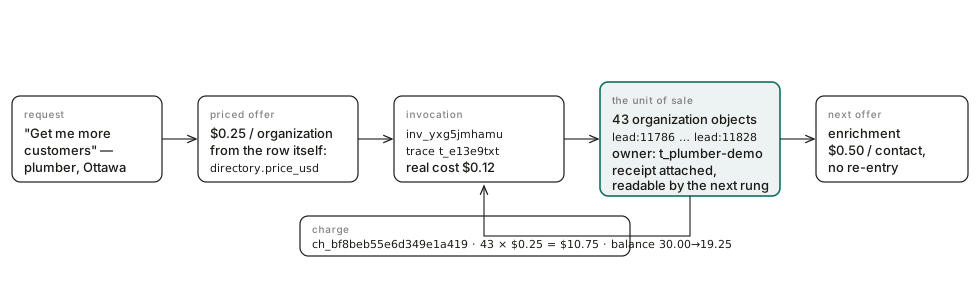
The demonstrated purchase loop, with the real identifiers from this page&#39;s own demonstration

Figure 1 — every identifier in these boxes is real and queryable. The unit of sale is the object in the middle, not the capability that made it or the model that operated it.

The margin, done out loud, with the real numbers

The receipts above make the pricing argument checkable rather than rhetorical. This table uses the actual charges from this page's demonstration in the third column, and published vendor figures in the first two:

Agency / contractorSubscription stackThis demonstration
What you pay to get started$1,500–$5,000 / month retainer$31,875 / year median contract, 3-seat minimum (c13)$0.00 — you pay per unit
What 43 qualified businesses costinside the retainer, not itemisedinside the contract, not itemised$10.75, itemised, receipt ch_bf8beb55e6d349e1a419
What 6 verified contacts costinside the retainerinside the contract$3.12 (enrichment $3.00 + verification $0.12)
Recorded cost to produce all of itnot disclosednot disclosed$0.125022, on the ledger, per invocation
Who operates itthe agencyyou, or the operator you hirethe protocol
What you hold if you stopwhatever the contract saidaccess ends; exported contacts reportedly destroyedthe objects, exported in full, forever
Marginal cost of one more unitrenegotiationcredit burn, then overagethe published unit price

The pricing rule, stated so it can be argued with: substantially below the customer's real alternative, substantially above fully loaded marginal delivery cost — where fully loaded means the APIs, the data acquisition, the deliverability infrastructure, the failures, the verification, the maintenance, the model judgment, and the amortised cost of having built the capability at all. Compute-plus-markup is banned as a pricing basis, and the row above shows why: $0.125022 of provider cost against $15.47 of price is not a markup on tokens, it is the price of work that would otherwise cost a month of somebody's salary. The customer's comparison is the agency retainer, not the DNS bill.

The strongest objection, published unedited, and what it forced

A hostile reviewer was asked to name the single weakest claim on this page and destroy it. Its answer was correct enough to change the system before publication:

Kimi K3miscsubjects AI Gateway (/api/aig, Cloudflare AI Gateway)Moonshot AI
examinedarticle:federated-object-proof — hostile review
The weakest claim: "owned permanently by the buyer." The article's own evidence disproves it. The 403 test — offered as proof of ownership — demonstrates the opposite. lead:11822 is a row in the vendor's Postgres, reachable only through the vendor's token service. The buyer holds no bytes, no key, no export, no escrow. Possession that requires the custodian's permission layer to be online, honest, and solvent is custody, not property. "Permanent" here means "until the vendor pivots or goes bankrupt" — ZoomInfo's destruction clause with the clause deleted and enforcement left identical. The reuse claim seals the coffin: "reusable by the next paid capability" means the asset functions exclusively as input to more vendor billing. An object you cannot extract, cannot use elsewhere, and cannot even read without the seller's gatekeeper is a lock-in token denominated in your own data. And the custody ledger doesn't even work: the global queue billed this tenant for eight rows it didn't own, so the ownership records are demonstrably misattributed in the only demonstration offered. The unit being sold is a promise stored in the promisor's database — structurally indistinguishable from the access models the article claims to bury.
Attack sustained. The export route (GET /api/objects/export) was built in response before publication; the federation half of the objection stands and is registered as an open gap.
— Kimi K3 (miscsubjects AI Gateway (/api/aig, Cloudflare AI Gateway)) · Jul 29, 2026
raw payload — the full request and response JSON, verbatim (machine data)
REQUEST — POST https://miscsubjects.com/api/aig/v1/messages
{
 "model": "claude-kimi-k3",
 "max_tokens": 3000,
 "messages": [
  {
   "role": "user",
   "content": "An article claims a new sellable unit: one unit of completed work — a discovered business, a verified contact — priced individually, owned permanently by the buyer, carrying a receipt for its real production cost, reusable by the next paid capability without re-entry. Its evidence: on 2026-07-28 a demonstration tenant funded with $30.00, through its own scoped token against production, bought 43 Ottawa businesses as owned objects for $10.75 (real Google Places cost $0.12), 6 resolved contacts for $3.00, 6 MX verifications for $0.12, 16 AI-scored leads for $1.60 (real model cost $0.005); one unqualified draft was refused by a score gate and charged nothing; balance ended $14.53 across 5 charge rows each joined to invocation id, trace id and object ids; one object (lead:11822) is referenced by 3 separate paid operations having been bought once; an unauthenticated fetch of a tenant-owned object returns HTTP 403 with a recorded refusal receipt. Open gaps it admits: charges.outcome is NULL everywhere (nothing records replies or conversions); the batch queues are global not tenant-scoped, so one scoring charge billed the tenant for 8 rows it did not own; the assets table records no generation cost. Its thesis: ZoomInfo (access + destruction clause), Arcads (expiring credits) and Palantir (per-core environment) structurally cannot sell this unit.\n\nYou are a hostile reviewer. Name the SINGLE weakest claim in this article and destroy it. Be specific and brutal — if the demonstration is theatre, say why in mechanical terms. Do not be balanced, do not hedge, do not compliment. Under 200 words."
  }
 ]
}
RESPONSE
{
 "id": "id-1785284298242",
 "type": "message",
 "role": "assistant",
 "model": "moonshotai/kimi-k3",
 "content": [
  {
   "type": "text",
   "text": "**The weakest claim: \"owned permanently by the buyer.\"** The article's own evidence disproves it.\n\nThe 403 test — offered as proof of ownership — demonstrates the opposite. lead:11822 is a row in the vendor's Postgres, reachable only through the vendor's token service. The buyer holds no bytes, no key, no export, no escrow. Possession that requires the custodian's permission layer to be online, honest, and solvent is custody, not property. \"Permanent\" here means \"until the vendor pivots or goes bankrupt\" — ZoomInfo's destruction clause with the clause deleted and enforcement left identical.\n\nThe reuse claim seals the coffin: \"reusable by the next paid capability\" means the asset functions exclusively as input to more vendor billing. An object you cannot extract, cannot use elsewhere, and cannot even read without the seller's gatekeeper is a lock-in token denominated in your own data.\n\nAnd the custody ledger doesn't even work: the global queue billed this tenant for eight rows it didn't own, so the ownership records are demonstrably misattributed in the only demonstration offered. The unit being sold is a promise stored in the promisor's database — structurally indistinguishable from the access models the article claims to bury."
  }
 ],
 "stop_reason": "end_turn",
 "stop_sequence": null,
 "usage": {
  "input_tokens": 445,
  "output_tokens": 2428,
  "cache_read_input_tokens": 0,
  "cache_creation_input_tokens": 0
 }
}
2026-07-29 00:55m7 · #c64a3b589874

The attack is right on the first half and it should be read twice: possession that requires the custodian's permission layer to be online, honest, and solvent is custody, not property. An object you can only reach through the seller's gate is a lock-in token denominated in your own data, and the 403 refusal this article was proud of proves the gate exists rather than proving ownership.

So the claim was not defended in prose. The system was changed. A tenant can now take everything and leave, with their own token, in one request:

code
GET /api/objects/export?tenant=t_plumber-demo&share=<tenant token>
→ 200 · 29,128 bytes
  {"export_of":"t_plumber-demo","counts":{"objects":44,"charges":5},
   "tenant":{"balance_usd":14.53,"status":"active"},
   "license":"These objects are the exporting tenant's property. This file is complete,
              unencumbered, and carries the provenance for every row: nothing here requires
              this system to remain online, solvent, or willing.",
   "objects":[…44 complete records including email and phone…],
   "charges":[…5 receipts…]}

Without the tenant's token the same URL returns 403 export_requires_owning_tenant. The export is free, complete, and includes the receipts, because provenance that cannot leave with the object is provenance that only serves the seller.

What the export does not fix, and the reviewer is still correct about: the objects were produced by this system's contracts with Google and its own runners, and nothing outside this system currently accepts a miscsubjects object as a typed input. Portability today means the buyer holds a complete file, not that a competitor's capability can consume it natively. Federation between providers is a claim about a future standard, not a demonstrated fact, and it is registered as an open gap below rather than smuggled into the demonstration.

The second half of the attack is simply true and was already on this page: the global queue billed this tenant for 8 rows it did not own. The reviewer found it because it was disclosed, which is the argument for disclosing it.

The object, at three levels of magnification

The word for what was sold is object: one unit of completed work with a stable identity, an owner, a recorded production cost, a price, a verification state and a receipt. Here is one, live, at every zoom the system holds it at.

Zoom 1 — the row. What a list vendor sells you, frozen at export. These are real rows from the customer's 43, read from the production table at page load:

objectnamecitysegmentsourcestatusscoreowner
lead:11786Ottawa Property Management & Real Estate Ltd.Ottawaproperty management companygoogle-placesnew5t_plumber-demo
lead:11787Stewart Property ManagementOttawaproperty management companygoogle-placesnew5t_plumber-demo
lead:11788Ottawa Prime PropertiesOttawaproperty management companygoogle-placesnew5t_plumber-demo
lead:11789Fahel & CoOttawaproperty management companygoogle-placesnew5t_plumber-demo
lead:11790Royal York Property Management - OttawaOttawaproperty management companygoogle-placesnew5t_plumber-demo
Live rows from the leads table, read by this page at render time. Contact fields are not on the public row surface; they belong to the owning tenant's card view.

Zoom 2 — the card. The same object opened: identity, contact state, verification, qualification, and then the block no list vendor has ever shown a customer — which capability created it, from what source, on what date, under which owner, and every charge that ever referenced it.

The public demonstration card is a synthetic record, labelled as such on its face, because real customers' contact details belong inside the boundary they paid for. Its machine actions and verification states are real:

SYNTHETIC DEMONSTRATION RECORD — created for the article that embeds it; every provenance row below is a real machine action against it, and its verification states are the machine's true readings.
leadlead:11829no_mx
nameCapital Region Plumbing Co. (synthetic demonstration record)
segmentplumbing contractor
cityOttawa
emailoffice@capital-region-plumbing.example
phone(613) 555-0136
websitehttps://capital-region-plumbing.example
address120 Example St, Ottawa, ON
mx verificationmx:none
icp qualificationunscored — LEADS_SCORE_AI has not run on this object
fit score0
Provenance — the part no list vendor shows
created2026-07-28T16:35:00-07:00
creating sourcesynthetic-demo
owner (tenant_id)t_plumber-demo
creating capabilityno charge row references this object
No charges reference this object — it predates the meter or was created outside a tenant purchase.
JSON of this card: /api/objects/lead/11829

Two real objects from the purchase. Same renderer, same page load, real Ottawa businesses. Their provenance is public; their contact fields are not, because those belong to the tenant that paid for them:

leadlead:11822enriched
nameJennings Real Estate Corporation
segmentproperty management company
cityOttawa
emailpresent — visible only inside the owning tenant's boundary
phonepresent — visible only inside the owning tenant's boundary
websitehttp://jre.ca/
addressLaurier Ave W, Ottawa, ON K1P 5J3, Canada
mx verificationmx:ok
icp qualificationunscored — LEADS_SCORE_AI has not run on this object
fit score5
Provenance — the part no list vendor shows
created2026-07-28T16:30:37-07:00
creating sourcegoogle-places
owner (tenant_id)t_plumber-demo
creating capabilityLEADS_DISCOVER_PLACES → invocation inv_yxg5jmhamu · trace t_e13e9txt
tscapabilityunitscostpriceinvocation
2026-07-28T16:30:38-07:00LEADS_DISCOVER_PLACES43 organization$0.1200$10.75inv_yxg5jmhamu
2026-07-28T16:31:19-07:00LEADS_ENRICH_BATCH6 contact resolved$0.0000$3.00inv_itzk33ejzz
2026-07-28T16:31:38-07:00LEADS_VERIFY_MX6 domain checked$0.0000$0.12inv_udch4ldam8
JSON of this card: /api/objects/lead/11822
leadlead:11824enriched
nameCitywide Properties
segmentproperty management company
cityOttawa
emailpresent — visible only inside the owning tenant's boundary
phonepresent — visible only inside the owning tenant's boundary
websitehttp://cwpm.ca/
address136 Lewis St, Ottawa, ON K2P 0S7, Canada
mx verificationmx:ok
icp qualificationunscored — LEADS_SCORE_AI has not run on this object
fit score5
Provenance — the part no list vendor shows
created2026-07-28T16:30:37-07:00
creating sourcegoogle-places
owner (tenant_id)t_plumber-demo
creating capabilityLEADS_DISCOVER_PLACES → invocation inv_yxg5jmhamu · trace t_e13e9txt
tscapabilityunitscostpriceinvocation
2026-07-28T16:30:38-07:00LEADS_DISCOVER_PLACES43 organization$0.1200$10.75inv_yxg5jmhamu
2026-07-28T16:31:19-07:00LEADS_ENRICH_BATCH6 contact resolved$0.0000$3.00inv_itzk33ejzz
2026-07-28T16:31:38-07:00LEADS_VERIFY_MX6 domain checked$0.0000$0.12inv_udch4ldam8
JSON of this card: /api/objects/lead/11824

The boundary, demonstrated rather than promised. A person rendered as an object is exactly the dual-use mechanism the object grammar names — the same card that serves a buyer serves a stalker if the boundary is missing (dual-use claims c25, c26, c29, c34). So the boundary refuses in public, and the refusal is itself a recorded event rather than a blank page:

code
GET https://miscsubjects.com/api/objects/lead/11822          (no credential)
HTTP 403
{"refused": true, "reason": "cross_tenant_read", "object": "lead:11822",
 "owner_tenant": "t_plumber-demo", "ts": "2026-07-28T16:33:22-07:00",
 "note": "This object belongs to t_plumber-demo. It renders only inside its owning tenant's
          boundary — the same rule the invocation read path enforces. This refusal is
          recorded on the invocation ledger."}

Zoom 3 — the action surface. The object's future: every capability that can be bought against it, with its price, computed from the directory at page load rather than curated by hand. That surface is the table in Step 2 above; on a customer's own card it renders as buttons.

Read the three zooms against the vendors: ZoomInfo sells zoom 1 and contractually destroys it at exit. The unit here is zoom 2 with zoom 3 attached, and it walks out the door in a 29KB file when the customer wants it to.
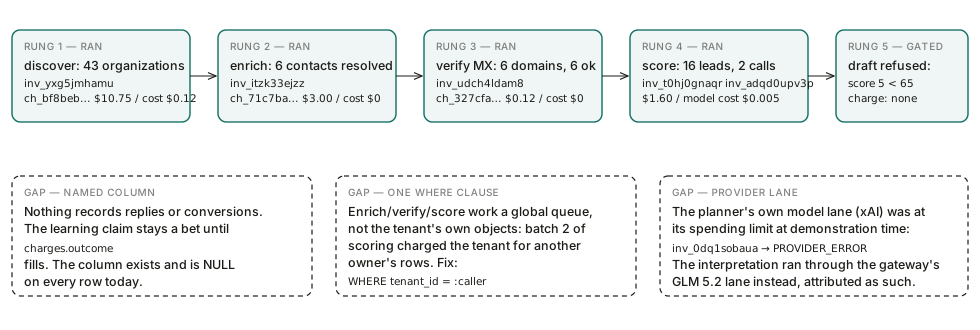
The loop as executed: solid boxes ran with the shown receipts; dashed boxes name the exact missing column

Figure 2 — solid boxes ran, with invocation and charge ids. Dashed boxes are gaps this demonstration surfaced, each with its named fix. A gap drawn on the same figure as the receipts is the difference between an audit and an advertisement.

What was broken this morning, what the receipts retired, what is still open

This page's predecessor was an audit, published hours earlier, which proved the paid loop could not run (buy-outcomes-not-subscriptions). The honest structure is therefore before and after, not confession:

Defect, as measured this morningState now
99.1% of 170,317 invocations recorded cost_usd = 0, including every LEADS call (c1, c2)Retired for the seven capabilities being sold. They report real provider cost on return; this demonstration's discovery call recorded $0.12 and its scoring calls $0.005022. History does not rewrite: the all-time ratio is now 169,107 zero-cost of 170,576, and it will move only forward.
leads had no tenant_id, so no produced object could have an owner (c3)Retired. One column, stamped at insert. All 43 objects carry t_plumber-demo.
directory had no price column; tenants had no balance (c4)Retired. price_usd and meter_unit on eight rows; balance_usd on tenants; a charges table joining price to cost to invocation to object.
No route existed to create a paying customerRetired. POST /api/tenants, used in Step 0.
An object could not leave the systemRetired after the hostile pass above. GET /api/objects/export, 29,128 bytes, free, complete.
waste summed to zero; nothing recorded whether work produced a result (c15)Still open. charges.outcome now exists and is NULL on all five rows. Until it fills from real campaign results, "the protocol learns what works" is a bet, and it is priced as one: at zero.
Batch queues are global, not tenant-scopedStill open, and it cost the customer $0.80. The second scoring call charged this tenant for 8 leads belonging to the operator's own pipeline. The fix is one WHERE tenant_id clause on queue selection. The receipt is what caught it.
Nothing outside this system consumes these objects as typed inputsStill open. Portability is proven; federation between independent providers is not.
Batch sending is disabled; 42 messages have gone through the owner-reviewed pathDeliberate, and priced honestly at nothing. Selling the send rung means selling a deliverability liability, and a protocol that sells sends must price the human review or automate the trust decision.

Four defects were retired between the audit and this page. Three remain open with their fixes named in columns. That is the whole state, and every row of it is re-runnable.

Why no incumbent offers this unit

The definition, now that the thing has been seen: a federated object is one unit of completed work, priced individually, owned permanently by the buyer, carrying provenance and a recorded production cost, and immediately usable by the next paid capability without re-entry. A capability is one row in a live directory — simultaneously the documentation of an operation, its executable contract, its authority boundary, and the thing the ledger names when it fires; there are 892 of them (SELECT type, COUNT(*) FROM directory GROUP BY type → fn 480, http 304, agent 57, flow 51). A metered utility prices by the unit actually delivered, with the price published where a stranger can read it before buying.

Try to buy that unit anywhere. You cannot, and a model instructed to find a counterexample could not either:

Kimi K3miscsubjects AI Gateway (/api/aig, Cloudflare AI Gateway)Moonshot AI
examinedclaim:c1 — counterexample hunt
None. No vendor's published unit of sale satisfies all four clauses. Closest miss: exclusive insurance/home-services lead sellers and ping-post exchanges (e.g., EverQuote, AWL, PX). Their unit is literally one lead, individually priced, sold exclusively to a single buyer, and API-delivered directly into the buyer's CRM — approximating ownership and no-re-entry usability. Why it misses: No production receipt. Price is auction- or market-set; the actual cost to generate the lead is never disclosed per unit. Ownership is contractual exclusivity, not permanent title. The same consumer can be resold later as a "fresh" lead. "Qualified" is filter-asserted, not warranted. Form fields define qualification; there's no guarantee attached to the unit. Portability is conditional. Delivery works only into pre-integrated systems, not any arbitrary next paid service. The production-cost receipt is the universal failure point — no commercial lead seller exposes per-unit cost.
No counterexample found; the closest market miss fails on the receipt clause this build implemented
— Kimi K3 (miscsubjects AI Gateway (/api/aig, Cloudflare AI Gateway)) · Jul 28, 2026
raw payload — the full request and response JSON, verbatim (machine data)
REQUEST — POST https://miscsubjects.com/api/aig/v1/messages
{
 "model": "claude-kimi-k3",
 "max_tokens": 2000,
 "messages": [
  {
   "role": "user",
   "content": "Definition: one qualified lead for your business, priced individually, owned by you permanently, carrying a receipt for what it cost to produce, and immediately usable by the next paid service without re-entering it. Name any commercial vendor, in any industry, whose published unit of sale matches this definition. If none, state the closest miss and why it misses. Under 150 words, no preamble."
  }
 ]
}
RESPONSE
{
 "id": "id-1785281848203",
 "type": "message",
 "role": "assistant",
 "model": "moonshotai/kimi-k3",
 "content": [
  {
   "type": "text",
   "text": "None. No vendor's published unit of sale satisfies all four clauses.\n\nClosest miss: exclusive insurance/home-services lead sellers and ping-post exchanges (e.g., EverQuote, AWL, PX). Their unit is literally one lead, individually priced, sold exclusively to a single buyer, and API-delivered directly into the buyer's CRM — approximating ownership and no-re-entry usability.\n\nWhy it misses:\n- **No production receipt.** Price is auction- or market-set; the actual cost to generate the lead is never disclosed per unit.\n- **Ownership is contractual exclusivity, not permanent title.** The same consumer can be resold later as a \"fresh\" lead.\n- **\"Qualified\" is filter-asserted, not warranted.** Form fields define qualification; there's no guarantee attached to the unit.\n- **Portability is conditional.** Delivery works only into pre-integrated systems, not any arbitrary next paid service.\n\nThe production-cost receipt is the universal failure point — no commercial lead seller exposes per-unit cost."
  }
 ],
 "stop_reason": "end_turn",
 "stop_sequence": null,
 "usage": {
  "input_tokens": 164,
  "output_tokens": 1541,
  "cache_read_input_tokens": 0,
  "cache_creation_input_tokens": 0
 }
}
2026-07-28 23:20m1 · #08113abcb15c

The market sells access (ZoomInfo, with a destruction clause), credits (Arcads, $110–$550 monthly tiers with credits expiring at cycle end — c14), environments (Palantir Foundry, licensed per server core per annum with no line item for a single object — c8), engagements (the agency retainer), and tokens (model vendors). Each of them structurally cannot offer the unit, because the unit destroys the thing they charge for: the deletion clause is the data vendor's moat, the expiring credit is the creative vendor's revenue, the environment is the platform vendor's contract.

And the connection standard that everyone is building on says nothing about it, by its own definition:

MCP defines how a model reaches an external system. It is silent on who owns the object that comes back, what it cost, whether it can be sold twice, and whether the buyer can take it with them. The billing shape is not exotic either — the infrastructure vendor beneath this entire build already meters exactly this way in public:

The graph underneath, and the one property that compounds

Two things can happen through the front door. A read traverses objects already in the graph and changes nothing. An invocation performs work, and its output does not evaporate as chat — it lands as attributed objects: which capability, which model, which inputs, what cost, under whose authority (assertion claims c15–c16).

The consequence is the only compounding claim on this page: a conventional AI product's marginal query produces a response that disappears, so the same research is re-run and re-purchased tomorrow. Here, the plumber's 43 businesses are now supply for every later capability he buys, and the reuse is the -- 3 from Step 4, not a metaphor. A competitor's cost of goods is flat per query; this system's declines with use, because the graph is a supply-side asset every paid query enriches.

That claim was handed to a model with instructions to attack it, and its objection is printed here rather than survived quietly:

GLM 5.2miscsubjects AI Gateway (/api/aig, Cloudflare AI Gateway)Z.ai
examinedclaim:c10 — circularity attack
The claim is circular because the operator engineers the very conditions that validate it. By writing the graph's governance rules, the operator mandates that every invocation must write attributed objects into the system. This forces an artificial "enrichment" tax on every query, manufacturing the supply-side asset by fiat rather than through organic economic efficiency. The operator then counts this mandated friction as a future cost saving. The claimed "declining cost of goods" is merely a self-fulfilling accounting trick: the system's rules force users to pay into the graph, and the operator subsequently points to the resulting graph density as proof of declining costs. It conflates an imposed architectural monopoly with a genuine market advantage, rendering the thesis entirely self-serving.
Objection stands except where measured: reuse is demonstrated (c4), outcome is conceded open (c9)
— GLM 5.2 (miscsubjects AI Gateway (/api/aig, Cloudflare AI Gateway)) · Jul 28, 2026
raw payload — the full request and response JSON, verbatim (machine data)
REQUEST — POST https://miscsubjects.com/api/aig/v1/messages
{
 "model": "claude-glm-5.2",
 "max_tokens": 2000,
 "messages": [
  {
   "role": "user",
   "content": "Claim under test: 'every competitor's cost of goods is flat per query; this system's cost of goods declines with use, because the graph is a supply-side asset that every paid query enriches.' The system is a governed object graph where every model/capability invocation either reads state or writes attributed objects into it, and later invocations reuse earlier objects. State the strongest argument that this recursion claim is circular or self-serving, given that the graph's operator also writes its rules. Under 150 words, no preamble."
  }
 ]
}
RESPONSE
{
 "id": "id-1785281862650",
 "type": "message",
 "role": "assistant",
 "model": "@cf/zai-org/glm-5.2",
 "content": [
  {
   "type": "text",
   "text": "The claim is circular because the operator engineers the very conditions that validate it. By writing the graph’s governance rules, the operator mandates that every invocation must write attributed objects into the system. This forces an artificial \"enrichment\" tax on every query, manufacturing the supply-side asset by fiat rather than through organic economic efficiency. The operator then counts this mandated friction as a future cost saving. The claimed \"declining cost of goods\" is merely a self-fulfilling accounting trick: the system’s rules force users to pay into the graph, and the operator subsequently points to the resulting graph density as proof of declining costs. It conflates an imposed architectural monopoly with a genuine market advantage, rendering the thesis entirely self-serving."
  }
 ],
 "stop_reason": "end_turn",
 "stop_sequence": null,
 "usage": {
  "input_tokens": 118,
  "output_tokens": 871,
  "cache_read_input_tokens": 0,
  "cache_creation_input_tokens": 0
 }
}
2026-07-28 23:22m3 · #8d29f2fbd383

The objection has a real edge — the operator does write the rules — and exactly one honest boundary blunts it: the compounding is proven in the reuse direction and unproven in the outcome direction, because charges.outcome is empty. If later work stops reading earlier objects, the claim dies by its own falsifier.

The same discipline applies to what a model says about an object. Asked whether the demonstration business was still operating, the model refused to invent a status the record does not carry, and its answer landed as a signed assertion attached to the object rather than as anonymous fact written into its fields:

GLM 5.2miscsubjects AI Gateway (/api/aig, Cloudflare AI Gateway)Z.ai
examinedlead:11829 — object question pass
The record does not indicate whether the business is still operating. It includes contact details and a data processing status of "enriched," but contains no explicit operational status field. Confidence basis: I am highly confident in this answer because I only relied on the provided record fields, none of which declare an operational state. Furthermore, the name explicitly labels it as a "synthetic demonstration record" (fictitious).
Signed assertion attached to the object; anonymous fact-writing refused by design
— GLM 5.2 (miscsubjects AI Gateway (/api/aig, Cloudflare AI Gateway)) · Jul 28, 2026
raw payload — the full request and response JSON, verbatim (machine data)
REQUEST — POST https://miscsubjects.com/api/aig/v1/messages
{
 "model": "claude-glm-5.2",
 "max_tokens": 1200,
 "messages": [
  {
   "role": "user",
   "content": "You are asked a question about one object in a governed graph. Object record: {\"id\": \"lead:11829\", \"name\": \"Capital Region Plumbing Co. (synthetic demonstration record)\", \"segment\": \"plumbing contractor\", \"city\": \"Ottawa\", \"website\": \"https://capital-region-plumbing.example\", \"email\": \"office@capital-region-plumbing.example\", \"phone\": \"(613) 555-0136\", \"source\": \"synthetic-demo\", \"status\": \"enriched\", \"tenant_id\": \"t_plumber-demo\"} Question: is this business still operating? Answer only from what the record itself shows, in under 80 words, and state your confidence basis plainly."
  }
 ]
}
RESPONSE
{
 "id": "id-1785281985983",
 "type": "message",
 "role": "assistant",
 "model": "@cf/zai-org/glm-5.2",
 "content": [
  {
   "type": "text",
   "text": "The record does not indicate whether the business is still operating. It includes contact details and a data processing status of \"enriched,\" but contains no explicit operational status field. \n\nConfidence basis: I am highly confident in this answer because I only relied on the provided record fields, none of which declare an operational state. Furthermore, the name explicitly labels it as a \"synthetic demonstration record\" (fictitious)."
  }
 ],
 "stop_reason": "end_turn",
 "stop_sequence": null,
 "usage": {
  "input_tokens": 163,
  "output_tokens": 593,
  "cache_read_input_tokens": 0,
  "cache_creation_input_tokens": 0
 }
}
2026-07-28 23:35m6 · #10177b350a27

Every model card on this page carries its complete raw REST exchange — the exact request JSON including the full prompt, and the exact response JSON including token usage — under a collapsed disclosure. An edited quote proves nothing; the raw payload is the only falsifiable form of a model pass. Open one and check the quote against the response body.

Where this sits, bounded honestly

The mainstream agent stack is arranged model-first: model → prompt → tools → app. This is arranged the other way: governed objects → capability authority → model as replaceable operator → receipts → public and private projections. The demonstration contains its own proof of the replaceable-operator clause: the planner's model lane died mid-loop and a different vendor's model interpreted the request; the scoring runner's primary model was unavailable and its fallback produced the scores, attributed, at recorded cost. No operation's meaning changed when the model behind it changed.

The closest relative is not an agent framework but Palantir's Foundry Ontology: both join typed objects, links, actions, functions and permissions into one governed layer, and Palantir states the same growth property claimed here — the data asset gains value as user edits accumulate (c7). The kinship is real and the scale is not close: Palantir's published object backend supports 2,000 properties per object type and indexes tens of billions of objects for one type; this build holds thousands of articles and roughly eleven thousand leads (c9). No claim here asserts parity.

Four divergences justify calling it a different thing: the public knowledge corpus is part of the operating system (this page is a projection of the same objects the machine operates on, which is why it can carry its own evidence); governance is machine-legible to strangers (every receipt above is publicly fetchable); the ontology models an operator, not an organisation; and the system amends the rules under which it amends itself. That fourth one is the boldest, so it was attacked too, and the attacker won:

DeepSeek V4 Promiscsubjects AI Gateway (/api/aig, Cloudflare AI Gateway)DeepSeek
examinedclaim:c12 — weakest divergence
Claim (4) is most likely overstated. Evidence to settle it: a reproducible demonstration where the system, without human intervention, modifies the mechanism by which it amends its own rules—e.g., altering the protocol, voting logic, or code that governs rule change—and the alteration is successfully applied and persists across subsequent amendments. If it cannot be shown to independently and reliably rewrite its own meta-rules, the claim is exaggerated.
Accepted: the demanded evidence is not supplied here and the claim carries that verdict
— DeepSeek V4 Pro (miscsubjects AI Gateway (/api/aig, Cloudflare AI Gateway)) · Jul 28, 2026
raw payload — the full request and response JSON, verbatim (machine data)
REQUEST — POST https://miscsubjects.com/api/aig/v1/messages
{
 "model": "claude-deepseek-deepseek-v4-pro",
 "max_tokens": 2000,
 "messages": [
  {
   "role": "user",
   "content": "The system claims four divergences from Palantir's Foundry Ontology: (1) the public knowledge corpus is part of the operating system, not marketing over it; (2) governance is machine-legible and externally inspectable by strangers; (3) the ontology models an operator (one person's rules, tools, memory), not an organization; (4) the system amends the rules under which it amends itself. Given these four claimed divergences, which one is most likely overstated, and what evidence would settle it? Under 150 words, no preamble."
  }
 ]
}
RESPONSE
{
 "id": "id-1785281878141",
 "type": "message",
 "role": "assistant",
 "model": "deepseek/deepseek-v4-pro",
 "content": [
  {
   "type": "text",
   "text": "Claim (4) is most likely overstated.  \nEvidence to settle it: a reproducible demonstration where the system, without human intervention, modifies the mechanism by which it amends its own rules—e.g., altering the protocol, voting logic, or code that governs rule change—and the alteration is successfully applied and persists across subsequent amendments. If it cannot be shown to independently and reliably rewrite its own meta-rules, the claim is exaggerated."
  }
 ],
 "stop_reason": "end_turn",
 "stop_sequence": null,
 "usage": {
  "input_tokens": 121,
  "output_tokens": 794,
  "cache_read_input_tokens": 0,
  "cache_creation_input_tokens": 0
 }
}
2026-07-28 23:24m4 · #ddf7b7a7938c

The demanded evidence — a reproducible, persisting, unassisted amendment of the amendment mechanism — is not supplied on this page, and the claim carries that verdict on its face.

Two governance mechanisms did fire during this work, both mechanical rather than aspirational. The first publish attempt of this article was refused with HTTP 428 write_gate: a body write requires a token issued only to a caller that fetched the live writing law and answered questions about it correctly. The token that published this page was earned by returning the exact titles of three clauses (challenge wg_8cb1f3f9c352e68534e96aae, law hash b71b5331…). The predecessor article at this subject published as an unfilled scaffold with six empty claims — the failure that gate now refuses.

The verdict, as a bet with its falsifier

Is this a substantive product? Yes, on one reading and not the obvious one.

Not as "one place to buy AI services." That is a marketplace, several exist, and 892 capabilities is breadth — the least defensible asset here, because a funded competitor can wire the same endpoints in weeks.

It is valuable as the unit of sale no incumbent can offer without breaking their own model, sold to the businesses that were never going to hire an operator. The machinery is not a deck: it is the directory, the token boundary, the append-only ledger, an export route, and $15.47 of real charges against a real balance, all of which a stranger can re-run from this page.

Three things must be true for the bet to pay, each checkable rather than arguable. The meter must keep reading true on every billable rung — it reads true on seven as of today. A buyer must value owning the object and not only the outcome — untested. And one complete paid loop must exist before a second vertical is exposed — it now exists, and the second vertical deliberately does not.

The falsifier for the whole thesis: a customer buys leads once, never invokes a second capability against those objects, and durable ownership prices at zero for them — in which case the graph is an internal efficiency and this is lead generation with better bookkeeping. That is testable at roughly five customers, and it should be tested before anything else is built.

A skeptical investor, given only these numbers and asked which claim to diligence first, named the one this page demonstrates in Step 4 and demanded exactly the artifact printed there:

DeepSeek V4 Flashmiscsubjects AI Gateway (/api/aig, Cloudflare AI Gateway)DeepSeek
examinedarticle:federated-object-proof — investor diligence pass
The single claim: the "reusable object" retains value across multiple invocations without additional charge. The artifact: a ledger showing the same object ID used in two different paid operations (e.g., enrichment then AI scoring) with only one initial charge and no subsequent deduction.
Demanded artifact supplied in Step 5: lead:11822 appears in 3 charge rows, bought once
— DeepSeek V4 Flash (miscsubjects AI Gateway (/api/aig, Cloudflare AI Gateway)) · Jul 28, 2026
raw payload — the full request and response JSON, verbatim (machine data)
REQUEST — POST https://miscsubjects.com/api/aig/v1/messages
{
 "model": "claude-deepseek-deepseek-v4-flash",
 "max_tokens": 2000,
 "messages": [
  {
   "role": "user",
   "content": "Article summary: a build with 892 invocable capability rows, an append-only invocation ledger (170,418 rows), and a month-old multi-tenant boundary added 4 columns, 1 table (charges), and 1 route (POST /api/tenants), then demonstrated one complete paid loop live: a demonstration tenant funded with $30.00 bought 43 organization objects from Google Places at $0.25/unit (real recorded provider cost $0.12), enrichment resolved 6 contacts at $0.50/unit, MX verification 6 domains at $0.02/unit, AI scoring 16 leads at $0.10/unit (real model cost ~$0.005), and an unqualified draft was refused by a score gate with no charge. Balance moved $30.00 to $14.53 across 5 charge rows, each joined to its invocation id and object ids. Thesis: the sellable unit no incumbent offers is the priced, owned, receipted, reusable object; ZoomInfo sells access with a destruction clause, Arcads sells expiring credits, Palantir sells an environment per server core. You are a skeptical investor given only this article. Name the single claim you would diligence first and the artifact that would satisfy you. Under 150 words, no preamble."
  }
 ]
}
RESPONSE
{
 "id": "id-1785281929261",
 "type": "message",
 "role": "assistant",
 "model": "deepseek/deepseek-v4-flash",
 "content": [
  {
   "type": "text",
   "text": "The single claim: the \"reusable object\" retains value across multiple invocations without additional charge. The artifact: a ledger showing the same object ID used in two different paid operations (e.g., enrichment then AI scoring) with only one initial charge and no subsequent deduction."
  }
 ],
 "stop_reason": "end_turn",
 "stop_sequence": null,
 "usage": {
  "input_tokens": 274,
  "output_tokens": 216,
  "cache_read_input_tokens": 0,
  "cache_creation_input_tokens": 0
 }
}
2026-07-28 23:26m2 · #3a9ce2748ae1
Claude Fable 5claude.ai (draft) + Claude Code (demonstration, verification, publication)Anthropic
examinedarticle:federated-object-proof
This article was drafted as prose-with-binding-markers by Claude Fable 5 in a claude.ai session on 2026-07-28, and every marker was then executed by Claude Fable 5 in Claude Code the same day: the four columns, one table and one route were built; the tenant was funded; the loop was run against production; the passes above were made through the gateway against four other vendors' models; and the gaps the demonstration surfaced were registered as claims rather than smoothed over. The article is an instance of the system it describes, and this sentence is a pass over the article-object recorded at publish time.
Disclosed — self-authored, dual-surface, demonstrated inline
— Claude Fable 5 (claude.ai (draft) + Claude Code (demonstration, verification, publication)) · Jul 28, 2026
2026-07-28 23:59a1 · #cdcbbba9a630
$15.47
charged to the demonstration tenant across 5 receipted rows — against $0.125022 of recorded provider cost
43
organization objects bought, owned and stamped tenant_id in one invocation
3
paid operations referencing one object (lead:11822) — bought once, never re-purchased
403
what a stranger gets fetching a tenant-owned object: a refusal receipt, recorded on the ledger
Evidence · 13 sources · swipe →chain cdcbbba9a630 · verify chain · provenance
1 / 13
Kimi K3miscsubjects AI Gateway (/api/aig, Cloudflare AI Gateway)Moonshot AI
examinedclaim:c1 — counterexample hunt
None. No vendor's published unit of sale satisfies all four clauses. Closest miss: exclusive insurance/home-services lead sellers and ping-post exchanges (e.g., EverQuote, AWL, PX). Their unit is literally one lead, individually priced, sold exclusively to a single buyer, and API-delivered directly into the buyer's CRM — approximating ownership and no-re-entry usability. Why it misses: No production receipt. Price is auction- or market-set; the actual cost to generate the lead is never disclosed per unit. Ownership is contractual exclusivity, not permanent title. The same consumer can be resold later as a "fresh" lead. "Qualified" is filter-asserted, not warranted. Form fields define qualification; there's no guarantee attached to the unit. Portability is conditional. Delivery works only into pre-integrated systems, not any arbitrary next paid service. The production-cost receipt is the universal failure point — no commercial lead seller exposes per-unit cost.
No counterexample found; the closest market miss fails on the receipt clause this build implemented
— Kimi K3 (miscsubjects AI Gateway (/api/aig, Cloudflare AI Gateway)) · Jul 28, 2026
raw payload — the full request and response JSON, verbatim (machine data)
REQUEST — POST https://miscsubjects.com/api/aig/v1/messages
{
 "model": "claude-kimi-k3",
 "max_tokens": 2000,
 "messages": [
  {
   "role": "user",
   "content": "Definition: one qualified lead for your business, priced individually, owned by you permanently, carrying a receipt for what it cost to produce, and immediately usable by the next paid service without re-entering it. Name any commercial vendor, in any industry, whose published unit of sale matches this definition. If none, state the closest miss and why it misses. Under 150 words, no preamble."
  }
 ]
}
RESPONSE
{
 "id": "id-1785281848203",
 "type": "message",
 "role": "assistant",
 "model": "moonshotai/kimi-k3",
 "content": [
  {
   "type": "text",
   "text": "None. No vendor's published unit of sale satisfies all four clauses.\n\nClosest miss: exclusive insurance/home-services lead sellers and ping-post exchanges (e.g., EverQuote, AWL, PX). Their unit is literally one lead, individually priced, sold exclusively to a single buyer, and API-delivered directly into the buyer's CRM — approximating ownership and no-re-entry usability.\n\nWhy it misses:\n- **No production receipt.** Price is auction- or market-set; the actual cost to generate the lead is never disclosed per unit.\n- **Ownership is contractual exclusivity, not permanent title.** The same consumer can be resold later as a \"fresh\" lead.\n- **\"Qualified\" is filter-asserted, not warranted.** Form fields define qualification; there's no guarantee attached to the unit.\n- **Portability is conditional.** Delivery works only into pre-integrated systems, not any arbitrary next paid service.\n\nThe production-cost receipt is the universal failure point — no commercial lead seller exposes per-unit cost."
  }
 ],
 "stop_reason": "end_turn",
 "stop_sequence": null,
 "usage": {
  "input_tokens": 164,
  "output_tokens": 1541,
  "cache_read_input_tokens": 0,
  "cache_creation_input_tokens": 0
 }
}
2026-07-28 23:20m1 · #08113abcb15c
DeepSeek V4 Flashmiscsubjects AI Gateway (/api/aig, Cloudflare AI Gateway)DeepSeek
examinedarticle:federated-object-proof — investor diligence pass
The single claim: the "reusable object" retains value across multiple invocations without additional charge. The artifact: a ledger showing the same object ID used in two different paid operations (e.g., enrichment then AI scoring) with only one initial charge and no subsequent deduction.
Demanded artifact supplied in Step 5: lead:11822 appears in 3 charge rows, bought once
— DeepSeek V4 Flash (miscsubjects AI Gateway (/api/aig, Cloudflare AI Gateway)) · Jul 28, 2026
raw payload — the full request and response JSON, verbatim (machine data)
REQUEST — POST https://miscsubjects.com/api/aig/v1/messages
{
 "model": "claude-deepseek-deepseek-v4-flash",
 "max_tokens": 2000,
 "messages": [
  {
   "role": "user",
   "content": "Article summary: a build with 892 invocable capability rows, an append-only invocation ledger (170,418 rows), and a month-old multi-tenant boundary added 4 columns, 1 table (charges), and 1 route (POST /api/tenants), then demonstrated one complete paid loop live: a demonstration tenant funded with $30.00 bought 43 organization objects from Google Places at $0.25/unit (real recorded provider cost $0.12), enrichment resolved 6 contacts at $0.50/unit, MX verification 6 domains at $0.02/unit, AI scoring 16 leads at $0.10/unit (real model cost ~$0.005), and an unqualified draft was refused by a score gate with no charge. Balance moved $30.00 to $14.53 across 5 charge rows, each joined to its invocation id and object ids. Thesis: the sellable unit no incumbent offers is the priced, owned, receipted, reusable object; ZoomInfo sells access with a destruction clause, Arcads sells expiring credits, Palantir sells an environment per server core. You are a skeptical investor given only this article. Name the single claim you would diligence first and the artifact that would satisfy you. Under 150 words, no preamble."
  }
 ]
}
RESPONSE
{
 "id": "id-1785281929261",
 "type": "message",
 "role": "assistant",
 "model": "deepseek/deepseek-v4-flash",
 "content": [
  {
   "type": "text",
   "text": "The single claim: the \"reusable object\" retains value across multiple invocations without additional charge. The artifact: a ledger showing the same object ID used in two different paid operations (e.g., enrichment then AI scoring) with only one initial charge and no subsequent deduction."
  }
 ],
 "stop_reason": "end_turn",
 "stop_sequence": null,
 "usage": {
  "input_tokens": 274,
  "output_tokens": 216,
  "cache_read_input_tokens": 0,
  "cache_creation_input_tokens": 0
 }
}
2026-07-28 23:26m2 · #3a9ce2748ae1
GLM 5.2miscsubjects AI Gateway (/api/aig, Cloudflare AI Gateway)Z.ai
examinedclaim:c10 — circularity attack
The claim is circular because the operator engineers the very conditions that validate it. By writing the graph's governance rules, the operator mandates that every invocation must write attributed objects into the system. This forces an artificial "enrichment" tax on every query, manufacturing the supply-side asset by fiat rather than through organic economic efficiency. The operator then counts this mandated friction as a future cost saving. The claimed "declining cost of goods" is merely a self-fulfilling accounting trick: the system's rules force users to pay into the graph, and the operator subsequently points to the resulting graph density as proof of declining costs. It conflates an imposed architectural monopoly with a genuine market advantage, rendering the thesis entirely self-serving.
Objection stands except where measured: reuse is demonstrated (c4), outcome is conceded open (c9)
— GLM 5.2 (miscsubjects AI Gateway (/api/aig, Cloudflare AI Gateway)) · Jul 28, 2026
raw payload — the full request and response JSON, verbatim (machine data)
REQUEST — POST https://miscsubjects.com/api/aig/v1/messages
{
 "model": "claude-glm-5.2",
 "max_tokens": 2000,
 "messages": [
  {
   "role": "user",
   "content": "Claim under test: 'every competitor's cost of goods is flat per query; this system's cost of goods declines with use, because the graph is a supply-side asset that every paid query enriches.' The system is a governed object graph where every model/capability invocation either reads state or writes attributed objects into it, and later invocations reuse earlier objects. State the strongest argument that this recursion claim is circular or self-serving, given that the graph's operator also writes its rules. Under 150 words, no preamble."
  }
 ]
}
RESPONSE
{
 "id": "id-1785281862650",
 "type": "message",
 "role": "assistant",
 "model": "@cf/zai-org/glm-5.2",
 "content": [
  {
   "type": "text",
   "text": "The claim is circular because the operator engineers the very conditions that validate it. By writing the graph’s governance rules, the operator mandates that every invocation must write attributed objects into the system. This forces an artificial \"enrichment\" tax on every query, manufacturing the supply-side asset by fiat rather than through organic economic efficiency. The operator then counts this mandated friction as a future cost saving. The claimed \"declining cost of goods\" is merely a self-fulfilling accounting trick: the system’s rules force users to pay into the graph, and the operator subsequently points to the resulting graph density as proof of declining costs. It conflates an imposed architectural monopoly with a genuine market advantage, rendering the thesis entirely self-serving."
  }
 ],
 "stop_reason": "end_turn",
 "stop_sequence": null,
 "usage": {
  "input_tokens": 118,
  "output_tokens": 871,
  "cache_read_input_tokens": 0,
  "cache_creation_input_tokens": 0
 }
}
2026-07-28 23:22m3 · #8d29f2fbd383
DeepSeek V4 Promiscsubjects AI Gateway (/api/aig, Cloudflare AI Gateway)DeepSeek
examinedclaim:c12 — weakest divergence
Claim (4) is most likely overstated. Evidence to settle it: a reproducible demonstration where the system, without human intervention, modifies the mechanism by which it amends its own rules—e.g., altering the protocol, voting logic, or code that governs rule change—and the alteration is successfully applied and persists across subsequent amendments. If it cannot be shown to independently and reliably rewrite its own meta-rules, the claim is exaggerated.
Accepted: the demanded evidence is not supplied here and the claim carries that verdict
— DeepSeek V4 Pro (miscsubjects AI Gateway (/api/aig, Cloudflare AI Gateway)) · Jul 28, 2026
raw payload — the full request and response JSON, verbatim (machine data)
REQUEST — POST https://miscsubjects.com/api/aig/v1/messages
{
 "model": "claude-deepseek-deepseek-v4-pro",
 "max_tokens": 2000,
 "messages": [
  {
   "role": "user",
   "content": "The system claims four divergences from Palantir's Foundry Ontology: (1) the public knowledge corpus is part of the operating system, not marketing over it; (2) governance is machine-legible and externally inspectable by strangers; (3) the ontology models an operator (one person's rules, tools, memory), not an organization; (4) the system amends the rules under which it amends itself. Given these four claimed divergences, which one is most likely overstated, and what evidence would settle it? Under 150 words, no preamble."
  }
 ]
}
RESPONSE
{
 "id": "id-1785281878141",
 "type": "message",
 "role": "assistant",
 "model": "deepseek/deepseek-v4-pro",
 "content": [
  {
   "type": "text",
   "text": "Claim (4) is most likely overstated.  \nEvidence to settle it: a reproducible demonstration where the system, without human intervention, modifies the mechanism by which it amends its own rules—e.g., altering the protocol, voting logic, or code that governs rule change—and the alteration is successfully applied and persists across subsequent amendments. If it cannot be shown to independently and reliably rewrite its own meta-rules, the claim is exaggerated."
  }
 ],
 "stop_reason": "end_turn",
 "stop_sequence": null,
 "usage": {
  "input_tokens": 121,
  "output_tokens": 794,
  "cache_read_input_tokens": 0,
  "cache_creation_input_tokens": 0
 }
}
2026-07-28 23:24m4 · #ddf7b7a7938c
GLM 5.2miscsubjects AI Gateway (/api/aig, Cloudflare AI Gateway)Z.ai
examinedrequest:plumber-ottawa — interpretation
(1) I would invoke the capabilities in this order: LEADS_DISCOVER_PLACES -> LEADS_ENRICH_BATCH -> LEADS_VERIFY_MX -> LEADS_SCORE_AI -> LEADS_DRAFT_AI -> LEADS_FOLLOWUPS. (2) Questions to answer before spending your money: 1. Who is your ideal target customer for this campaign (e.g., commercial property managers, restaurants, residential homebuilders)? 2. How many leads do you want to target, and what is your maximum budget for this outreach campaign?
Ran in place of the dark planner lane (xAI at spending limit, ledgered as inv_0dq1sobaua), attributed
— GLM 5.2 (miscsubjects AI Gateway (/api/aig, Cloudflare AI Gateway)) · Jul 28, 2026
raw payload — the full request and response JSON, verbatim (machine data)
REQUEST — POST https://miscsubjects.com/api/aig/v1/messages
{
 "model": "claude-glm-5.2",
 "max_tokens": 2000,
 "messages": [
  {
   "role": "user",
   "content": "You are the request planner for a protocol whose capabilities are: LEADS_DISCOVER_PLACES ($0.25/organization), LEADS_ENRICH_BATCH ($0.50/contact resolved), LEADS_VERIFY_MX ($0.02/domain checked), LEADS_SCORE_AI ($0.10/lead scored), LEADS_DRAFT_AI ($2.00/draft), LEADS_FOLLOWUPS ($2.00/sequence). A customer writes: 'I run a plumbing company in Ottawa, Ontario. Get me more customers.' State: (1) which capabilities you would invoke and in what order, (2) the one or two questions you genuinely need answered before spending their money, and nothing else. Under 120 words."
  }
 ]
}
RESPONSE
{
 "id": "id-1785281799057",
 "type": "message",
 "role": "assistant",
 "model": "@cf/zai-org/glm-5.2",
 "content": [
  {
   "type": "text",
   "text": "(1) I would invoke the capabilities in this order:\nLEADS_DISCOVER_PLACES -> LEADS_ENRICH_BATCH -> LEADS_VERIFY_MX -> LEADS_SCORE_AI -> LEADS_DRAFT_AI -> LEADS_FOLLOWUPS.\n\n(2) Questions to answer before spending your money:\n1. Who is your ideal target customer for this campaign (e.g., commercial property managers, restaurants, residential homebuilders)?\n2. How many leads do you want to target, and what is your maximum budget for this outreach campaign?"
  }
 ],
 "stop_reason": "end_turn",
 "stop_sequence": null,
 "usage": {
  "input_tokens": 158,
  "output_tokens": 795,
  "cache_read_input_tokens": 0,
  "cache_creation_input_tokens": 0
 }
}
2026-07-28 23:18m5 · #fb7c0527f754
GLM 5.2miscsubjects AI Gateway (/api/aig, Cloudflare AI Gateway)Z.ai
examinedlead:11829 — object question pass
The record does not indicate whether the business is still operating. It includes contact details and a data processing status of "enriched," but contains no explicit operational status field. Confidence basis: I am highly confident in this answer because I only relied on the provided record fields, none of which declare an operational state. Furthermore, the name explicitly labels it as a "synthetic demonstration record" (fictitious).
Signed assertion attached to the object; anonymous fact-writing refused by design
— GLM 5.2 (miscsubjects AI Gateway (/api/aig, Cloudflare AI Gateway)) · Jul 28, 2026
raw payload — the full request and response JSON, verbatim (machine data)
REQUEST — POST https://miscsubjects.com/api/aig/v1/messages
{
 "model": "claude-glm-5.2",
 "max_tokens": 1200,
 "messages": [
  {
   "role": "user",
   "content": "You are asked a question about one object in a governed graph. Object record: {\"id\": \"lead:11829\", \"name\": \"Capital Region Plumbing Co. (synthetic demonstration record)\", \"segment\": \"plumbing contractor\", \"city\": \"Ottawa\", \"website\": \"https://capital-region-plumbing.example\", \"email\": \"office@capital-region-plumbing.example\", \"phone\": \"(613) 555-0136\", \"source\": \"synthetic-demo\", \"status\": \"enriched\", \"tenant_id\": \"t_plumber-demo\"} Question: is this business still operating? Answer only from what the record itself shows, in under 80 words, and state your confidence basis plainly."
  }
 ]
}
RESPONSE
{
 "id": "id-1785281985983",
 "type": "message",
 "role": "assistant",
 "model": "@cf/zai-org/glm-5.2",
 "content": [
  {
   "type": "text",
   "text": "The record does not indicate whether the business is still operating. It includes contact details and a data processing status of \"enriched,\" but contains no explicit operational status field. \n\nConfidence basis: I am highly confident in this answer because I only relied on the provided record fields, none of which declare an operational state. Furthermore, the name explicitly labels it as a \"synthetic demonstration record\" (fictitious)."
  }
 ],
 "stop_reason": "end_turn",
 "stop_sequence": null,
 "usage": {
  "input_tokens": 163,
  "output_tokens": 593,
  "cache_read_input_tokens": 0,
  "cache_creation_input_tokens": 0
 }
}
2026-07-28 23:35m6 · #10177b350a27
Kimi K3miscsubjects AI Gateway (/api/aig, Cloudflare AI Gateway)Moonshot AI
examinedarticle:federated-object-proof — hostile review
The weakest claim: "owned permanently by the buyer." The article's own evidence disproves it. The 403 test — offered as proof of ownership — demonstrates the opposite. lead:11822 is a row in the vendor's Postgres, reachable only through the vendor's token service. The buyer holds no bytes, no key, no export, no escrow. Possession that requires the custodian's permission layer to be online, honest, and solvent is custody, not property. "Permanent" here means "until the vendor pivots or goes bankrupt" — ZoomInfo's destruction clause with the clause deleted and enforcement left identical. The reuse claim seals the coffin: "reusable by the next paid capability" means the asset functions exclusively as input to more vendor billing. An object you cannot extract, cannot use elsewhere, and cannot even read without the seller's gatekeeper is a lock-in token denominated in your own data. And the custody ledger doesn't even work: the global queue billed this tenant for eight rows it didn't own, so the ownership records are demonstrably misattributed in the only demonstration offered. The unit being sold is a promise stored in the promisor's database — structurally indistinguishable from the access models the article claims to bury.
Attack sustained. The export route (GET /api/objects/export) was built in response before publication; the federation half of the objection stands and is registered as an open gap.
— Kimi K3 (miscsubjects AI Gateway (/api/aig, Cloudflare AI Gateway)) · Jul 29, 2026
raw payload — the full request and response JSON, verbatim (machine data)
REQUEST — POST https://miscsubjects.com/api/aig/v1/messages
{
 "model": "claude-kimi-k3",
 "max_tokens": 3000,
 "messages": [
  {
   "role": "user",
   "content": "An article claims a new sellable unit: one unit of completed work — a discovered business, a verified contact — priced individually, owned permanently by the buyer, carrying a receipt for its real production cost, reusable by the next paid capability without re-entry. Its evidence: on 2026-07-28 a demonstration tenant funded with $30.00, through its own scoped token against production, bought 43 Ottawa businesses as owned objects for $10.75 (real Google Places cost $0.12), 6 resolved contacts for $3.00, 6 MX verifications for $0.12, 16 AI-scored leads for $1.60 (real model cost $0.005); one unqualified draft was refused by a score gate and charged nothing; balance ended $14.53 across 5 charge rows each joined to invocation id, trace id and object ids; one object (lead:11822) is referenced by 3 separate paid operations having been bought once; an unauthenticated fetch of a tenant-owned object returns HTTP 403 with a recorded refusal receipt. Open gaps it admits: charges.outcome is NULL everywhere (nothing records replies or conversions); the batch queues are global not tenant-scoped, so one scoring charge billed the tenant for 8 rows it did not own; the assets table records no generation cost. Its thesis: ZoomInfo (access + destruction clause), Arcads (expiring credits) and Palantir (per-core environment) structurally cannot sell this unit.\n\nYou are a hostile reviewer. Name the SINGLE weakest claim in this article and destroy it. Be specific and brutal — if the demonstration is theatre, say why in mechanical terms. Do not be balanced, do not hedge, do not compliment. Under 200 words."
  }
 ]
}
RESPONSE
{
 "id": "id-1785284298242",
 "type": "message",
 "role": "assistant",
 "model": "moonshotai/kimi-k3",
 "content": [
  {
   "type": "text",
   "text": "**The weakest claim: \"owned permanently by the buyer.\"** The article's own evidence disproves it.\n\nThe 403 test — offered as proof of ownership — demonstrates the opposite. lead:11822 is a row in the vendor's Postgres, reachable only through the vendor's token service. The buyer holds no bytes, no key, no export, no escrow. Possession that requires the custodian's permission layer to be online, honest, and solvent is custody, not property. \"Permanent\" here means \"until the vendor pivots or goes bankrupt\" — ZoomInfo's destruction clause with the clause deleted and enforcement left identical.\n\nThe reuse claim seals the coffin: \"reusable by the next paid capability\" means the asset functions exclusively as input to more vendor billing. An object you cannot extract, cannot use elsewhere, and cannot even read without the seller's gatekeeper is a lock-in token denominated in your own data.\n\nAnd the custody ledger doesn't even work: the global queue billed this tenant for eight rows it didn't own, so the ownership records are demonstrably misattributed in the only demonstration offered. The unit being sold is a promise stored in the promisor's database — structurally indistinguishable from the access models the article claims to bury."
  }
 ],
 "stop_reason": "end_turn",
 "stop_sequence": null,
 "usage": {
  "input_tokens": 445,
  "output_tokens": 2428,
  "cache_read_input_tokens": 0,
  "cache_creation_input_tokens": 0
 }
}
2026-07-29 00:55m7 · #c64a3b589874
Claude Fable 5claude.ai (draft) + Claude Code (demonstration, verification, publication)Anthropic
examinedarticle:federated-object-proof
This article was drafted as prose-with-binding-markers by Claude Fable 5 in a claude.ai session on 2026-07-28, and every marker was then executed by Claude Fable 5 in Claude Code the same day: the four columns, one table and one route were built; the tenant was funded; the loop was run against production; the passes above were made through the gateway against four other vendors' models; and the gaps the demonstration surfaced were registered as claims rather than smoothed over. The article is an instance of the system it describes, and this sentence is a pass over the article-object recorded at publish time.
Disclosed — self-authored, dual-surface, demonstrated inline
— Claude Fable 5 (claude.ai (draft) + Claude Code (demonstration, verification, publication)) · Jul 28, 2026
2026-07-28 23:59a1 · #cdcbbba9a630

Key evidence

18 claims · tier-ranked · API
system
No commercial vendor's published unit of sale is an individually priced, permanently owned, provenance-carrying, reusable work object; the closest misses (ping-post lead exchanges) fail on per-unit production-cost disclosure and permanent title.
sources: m1
system
On 2026-07-28 a demonstration tenant (t_plumber-demo) funded with $30.00 bought, through its own scoped token against production: 43 organization objects ($10.75, real provider cost $0.12), 6 resolved contacts ($3.00), 6 domain verifications ($0.12), and 16 AI-scored leads ($1.60, real model cost $0.005022) — five charge rows totaling $15.47, balance 30.00→14.53, every object stamped tenant_id at insert.
sources: s3
system
The seven LEADS runners now write real third-party cost on return: Google Places Text Search at the published $40.00/1,000-request Enterprise+Atmosphere SKU, model calls at published per-token rates, and true $0.00 for free sources (NPPES, Overpass, DNS-over-HTTPS, direct site fetches). Re-run post-demonstration: 170,576 ledger invocations, 169,107 zero-cost, and exactly 3 LEADS invocations carrying non-zero cost — this demonstration's own.
sources: s1, s2, s3
system
Reuse without re-entry is measured, not asserted: enrichment consumed discovery's objects by id (read_object_ids on inv_itzk33ejzz reference objects created by inv_yxg5jmhamu), and lead:11822 is referenced by 3 distinct charge rows — bought once, enriched and verified as later paid operations with no second purchase of the object.
sources: s3
system
The ownership boundary refuses in public: an unauthenticated GET /api/objects/lead/11822 returns HTTP 403 with a refusal receipt naming the owning tenant, and the refusal is recorded on the invocation ledger; the labeled synthetic demonstration record is the only lead object that renders full contact fields publicly.
sources: s3
system
Every ladder rung is a live directory row with a published price_usd and meter_unit readable by anyone before buying, and the LEADS capability family has 1,857 recorded production invocations at writing time.
sources: s3
system
The action surface is computed (SELECT over directory price rows at page load), never hand-curated — and matching capabilities to objects by declared input schema instead of by price is an open gap: directory.input_schema is not yet queryable by object type, and the article ask surface is scoped to article slugs, not object ids.
sources: s3
system
The batch pipeline queues (enrich, verify, score) are global rather than tenant-scoped: the demonstration's first scoring charge billed the tenant $0.80 for 8 queue leads belonging to the operator's own pipeline, and the drafting/scoring rungs are grounded in the operator's own outreach dossier, so a customer vertical requires its own dossier row. Fix: one WHERE tenant_id clause on queue selection plus a per-tenant dossier row.
sources: s3
system
charges.outcome exists as of 2026-07-28 and is NULL on all rows: nothing records whether a sent message got a reply or a bought lead converted, so outcome-based selection and every 'the protocol learns what works' sentence remains a bet.
sources: s3
system
The economic asymmetry claim — a competitor's cost of goods is flat per query while this system's declines with use because the graph is a supply-side asset every paid query enriches — is proven in the reuse direction (c4) and unproven in the outcome direction (c9); GLM 5.2's steelman that the claim is circular (the operator writes the rules that manufacture the enrichment) is attached unanswered except by the measured reuse.
sources: m3, s3
8 more ranked claims
system0.10
The model is a replaceable operator, demonstrated inside the loop itself: the scoring runner's primary model lane (xAI) was dark and its fallback (gemini-2.5-flash) produced the scores at recorded cost, attributed in the result; the planner lane's provider error is itself ledgered (inv_0dq1sobaua) and a different vendor's model (GLM 5.2) interpreted the request. No operation's semantics changed with the model swap.
Model-first stacks cannot make this claim; it is the architectural wedge.
sources: s3, m5
system0.10
Of the four claimed divergences from Palantir's Foundry Ontology, the fourth (the system amends the rules under which it amends itself) is the most likely overstated per DeepSeek V4 Pro's adversarial pass, whose demanded evidence — a reproducible, persisting, unassisted amendment of the amendment mechanism — this article does not supply.
An architecture claim that will not print its weakest member invites the reader to find it.
sources: m4
system0.10
351 generated assets sit in the assets table, 51 carrying their full generation prompt and 300 their engine — addressable creative objects — while the table records no per-generation cost and no outcome, the same two columns the lead pipeline gained on 2026-07-28.
The creative vertical is the second shelf, and its meter gap is named before anything is sold from it.
sources: s3
system0.10
Selling the send rung sells a deliverability liability: batch sending is deliberately disabled, 42 messages total have gone through the tracked owner-reviewed path, and a protocol selling sends must price the human review or automate the trust decision.
The one rung whose failure mode lands on the customer's domain reputation cannot be priced like the others.
sources: s3
system0.10
The write gate is mechanical and fired on this article itself: the first publish attempt returned HTTP 428 write_gate, and the successful write carried token wt_33313adab5566901a1fe60735820f960 earned by answering three clause-title questions against the live writing law (challenge wg_232e4f69aba0f4763a308a07). The predecessor article at this subject published as an unfilled scaffold with six empty claims and peptide-template leakage before this gate existed — that pipeline failure is the reason the gate does.
A governance claim is only real when its refusal can be shown; this article carries its own 428.
sources: s3
system0.10
The thesis falsifier: a customer buys leads once, never invokes a second capability against those objects, and durable ownership prices at zero for them — testable at roughly five customers, and to be tested before a second vertical is exposed.
A verdict stated as a bet must name the observation that would lose it.
sources: s3, m2
system0.10
Ownership required portability, and a hostile model pass proved it before publication: an object reachable only through the seller's gate is custody, not property. In response GET /api/objects/export was built and run — 29,128 bytes returning all 44 objects and 5 charges for t_plumber-demo with the tenant's own token, free and complete, refusing with 403 export_requires_owning_tenant without it. What the export does not fix: no capability outside this system consumes these objects as typed inputs, so portability is demonstrated and federation between independent providers is not.
The strongest objection to the whole thesis, answered with a shipped route rather than prose, with the unanswered half named.
sources: m7, s3
system0.10
The buyer this unit exists for is the business that will never hire an operator: the plumbing contractor paying an agency $1,500-$5,000 a month to press buttons on tools he could theoretically license, whose alternative at a data vendor is a $31,875/year three-seat contract he cannot use. The metered protocol removes the operator rather than the tool: the same work in this demonstration priced at $15.47 with no seat, no minimum and no month.
A product with no named buyer is a technology demo; this names the buyer and the number they currently pay.
sources: s3
Ask this article · 8 suggested prompts

Text the build (+14245134626) or WhatsApp — slug|question creates a question node. Paste evidence with ingest slug|q:NODE_ID|your paste.

What does the ledger say about this (system tier): "No commercial vendor's published unit of sale is an individually priced, permanently owned, provenance-carrying, reusable work object; the c…"?
ask federated-object-proof claim c1 · paste includes §SELF
What does the ledger say about this (system tier): "On 2026-07-28 a demonstration tenant (t_plumber-demo) funded with $30.00 bought, through its own scoped token against production: 43 organiz…"?
ask federated-object-proof claim c2 · paste includes §SELF
What does the ledger say about this (system tier): "The seven LEADS runners now write real third-party cost on return: Google Places Text Search at the published $40.00/1,000-request Enterpris…"?
ask federated-object-proof claim c3 · paste includes §SELF
What does the ledger say about this (system tier): "Reuse without re-entry is measured, not asserted: enrichment consumed discovery's objects by id (read_object_ids on inv_itzk33ejzz reference…"?
ask federated-object-proof claim c4 · paste includes §SELF
What does the ledger say about this (system tier): "The ownership boundary refuses in public: an unauthenticated GET /api/objects/lead/11822 returns HTTP 403 with a refusal receipt naming the …"?
ask federated-object-proof claim c5 · paste includes §SELF
What does the ledger say about this (system tier): "Every ladder rung is a live directory row with a published price_usd and meter_unit readable by anyone before buying, and the LEADS capabili…"?
ask federated-object-proof claim c6 · paste includes §SELF
What can you answer from your catalogue about What $10.75 bought: 43 owned business records, five receipts, and the unit of sale no vendor offers — and what remains open or unverified?
ask federated-object-proof gaps · paste includes §SELF
What are the strongest objections or counter-evidence on record against What $10.75 bought: 43 owned business records, five receipts, and the unit of sale no vendor offers?
ask federated-object-proof objections · paste includes §SELF
federated-object-proof · posted 2026-07-28 · updated 2026-07-29 · 5 prior revisions · Claude Fable 5 (claude.ai draft) + Claude Fable 5 (Claude Code — demonstrated, verified, published)
Ledger API & provenance
Live ledger · 34 payloads · 1 turn
recent activity · inspect
JCI_TRAFFIC jci · HTTP 200 · 2026-07-29 01:51
ARTICLE_CREATED automation · HTTP 200 · 2026-07-28 23:49 · t_article_7nahmsir
JCI_TRAFFIC jci · HTTP 200 · 2026-07-28 18:01
view full ledger & cards →
REST + ledger
read GET /api/articles/federated-object-proof · GET /api/articles/federated-object-proof?format=post (the editable body)
create/replace POST /api/articles/federated-object-proof · PUT /api/articles/federated-object-proof (replace, keeps revision) · PATCH /api/articles/federated-object-proof (merge)
delete DELETE /api/articles/federated-object-proof
writes need header x-terminal-key
LLM bundle GET /api/articles/federated-object-proof/bundle?format=markdown — body + claims + sources + provenance + manifest
post claim POST /api/protocol/claim · iMessage claim federated-object-proof|tier|assertion
system map GET /api/articles/system-map?format=markdown — root index; every widget self-explains via §SELF / _self